1. Historical Foundations and Architectural Evolution
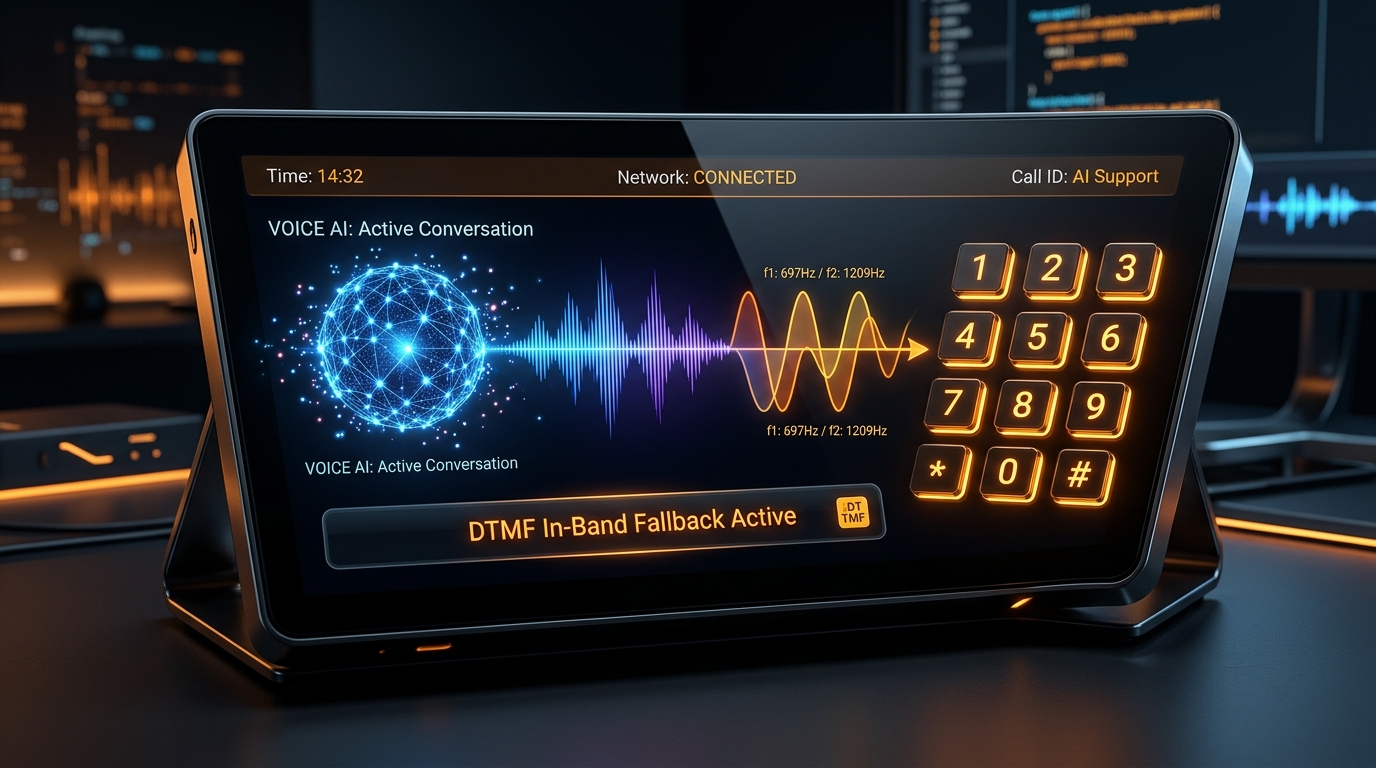
The global telecommunications landscape has undergone an extraordinary architectural transformation over the past three decades. The transition from legacy Time-Division Multiplexing (TDM) and Public Switched Telephone Network (PSTN) copper infrastructure to packet-switched Session Initiation Protocol (SIP) and Voice over IP (VoIP) fundamentally restructured real-time communications. Understanding the deep engineering principles of Implementing Graceful DTMF Fallback When Voice AI Confronts Noisy Lines requires tracing this trajectory from rigid circuit-switched networks to agile, software-defined IP architectures.
In traditional circuit-switched telephony, physical copper pairs and Class 5 central office switches allocated a dedicated 64 kbps Digital Signal 0 (DS0) channel for the entire duration of a telephone conversation. Regardless of whether participants were speaking or observing silence, that 64 kbps circuit remained occupied, guaranteeing zero packet jitter and constant latency at the expense of massive capital inefficiency. Signaling was isolated within the out-of-band Common Channel Signaling System No. 7 (SS7) network, utilizing Message Transfer Part (MTP) and ISDN User Part (ISUP) protocols inaccessible to end-user equipment.
The dawn of the internet protocol suite challenged this paradigm. In 1999, the Internet Engineering Task Force (IETF) published RFC 2543, subsequently refined in 2002 as RFC 3261, establishing the Session Initiation Protocol. Unlike SS7, SIP was intentionally designed as an application-layer text-based protocol modeled after HTTP and SMTP. This architectural decision democratized telecommunications, allowing commodity servers running Unix-like operating systems to parse, route, and terminate real-time voice sessions using standard IP networks.
However, decoupling real-time voice from dedicated physical circuits introduced profound technical challenges. IP networks are inherently asynchronous, packet-based, and best-effort. Voice packets traversing public transit networks encounter variable serialization delays, queueing jitter, and transient packet loss. Telecommunications engineers were forced to engineer sophisticated digital signal processing (DSP) algorithms, adaptive jitter buffers, and deterministic quality-of-service (QoS) tagging mechanisms to emulate the deterministic reliability of legacy copper circuits.
The progression toward IP-based telecommunications also radically transformed network security assumptions. In legacy SS7 environments, physical isolation provided a de facto security perimeter; only licensed telecommunications carriers possessed physical interconnections to central office switches. In contemporary IP telecommunications, signaling packets traverse the public internet, exposing SIP endpoints to automated port scanners, credential brute-forcing utilities, and distributed denial-of-service botnets. Securing this environment requires deploying specialized Session Border Controllers (SBCs) capable of rate-limiting rogue packets in hardware, terminating TLS cryptographic handshakes, and enforcing topological hiding to protect internal server topologies from external reconnaissance.
2. Mathematical Foundations, Traffic Modeling, and Digital Signal Processing
At the physical and transport layers, real-time voice communications are fundamentally governed by rigorous mathematical theorems. An architect designing systems around Implementing Graceful DTMF Fallback When Voice AI Confronts Noisy Lines must calculate bandwidth constraints, packet serialization delays, and queueing probabilities using formal mathematical modeling rather than guesswork.
2.1 The Nyquist-Shannon Sampling Theorem and Audio Quantization
The transmission of human speech begins with the conversion of continuous acoustic sound pressure waves into discrete binary pulse-code modulation (PCM). According to the Nyquist-Shannon sampling theorem, to preserve the complete information of an analog signal without aliasing distortion, the sampling frequency fs must strictly exceed twice the highest frequency component B present in the signal:
fs > 2B
In traditional PSTN telephony (narrowband), the acoustic passband is constrained to B = 4 kHz, requiring an 8 kHz sampling rate. Under G.711u (Pulse Code Modulation mu-law, standard in North America), each analog sample is logarithmically quantized to 8 bits using the piecewise linear compression characteristic:
F(x) = sgn(x) * ln(1 + mu * |x|) / ln(1 + mu), with mu = 255
Multiplying 8,000 samples per second by 8 bits per sample yields an exact raw payload bit rate of 64,000 bits per second (64 kbps). However, on modern packet networks, computing the real-world bandwidth requirement necessitates accounting for the complete transport encapsulation overhead:
- Ethernet Layer 2 Header and FCS: 18 bytes (or 22 bytes with 802.1Q VLAN tagging).
- IPv4 Layer 3 Header: 20 bytes (without options).
- UDP Layer 4 Header: 8 bytes.
- RTP Layer 5 Header: 12 bytes.
- G.711u Audio Payload (standard 20 ms packetization interval): 160 bytes.
The total frame size on the physical wire is 18 + 20 + 8 + 12 + 160 = 218 bytes. Transmitting 50 packets per second (one packet every 20 ms) results in a total network bandwidth consumption of:
Wire Bandwidth = 218 bytes * 8 bits/byte * 50 packets/sec = 87.2 kbps per concurrent call
An enterprise trunk carrying 100 simultaneous calls requires a dedicated non-bursting allocation of 8.72 Mbps solely for RTP media, excluding SIP signaling overhead and RTCP receiver reports. When configuring Quality of Service (QoS) queues on edge routers, engineers must budget for this total encapsulation overhead rather than the nominal 64 kbps codec rate.
2.2 Traffic Engineering: The Erlang B and Erlang C Formulations
When engineering high-concurrency telephony trunks for Implementing Graceful DTMF Fallback When Voice AI Confronts Noisy Lines, allocating a dedicated channel for every registered endpoint is financially unviable and technically inefficient. Enterprise voice traffic conforms to an Erlang B loss distribution model, which calculates the blocking probability Pb given offered traffic intensity E (in Erlangs) across m available concurrent trunk channels:
Pb = B(E, m) = [ (E^m / m!) ] / [ Sum_{k=0}^m (E^k / k!) ]
Where offered traffic E is defined as the arrival rate of call attempts lambda multiplied by the average call holding duration H:
E = lambda * H
If an enterprise call center experiences 600 incoming call attempts during the peak busy hour (lambda = 600 / 3600 = 0.1667 calls/second) with an average conversation holding time of 180 seconds (H = 180 s), the offered traffic intensity is:
E = 0.1667 * 180 = 30 Erlangs
To maintain a carrier-grade Grade of Service (GoS) where no more than 0.5% of incoming calls receive a busy rejection (Pb <= 0.005), the recursive Erlang B computation demonstrates that the enterprise requires exactly 42 concurrent SIP trunk channels. Provisioning fewer than 42 channels will result in caller busy signals; provisioning more than 45 channels wastes commercial operating budget.
In automated agentic call distribution systems where incoming calls are queued rather than blocked, engineers apply the Erlang C formula to determine the probability that an incoming call experiences queueing delay Pc:
Pc = C(E, m) = [ (E^m / m!) * (m / (m - E)) ] / [ Sum_{k=0}^{m-1} (E^k / k!) + (E^m / m!) * (m / (m - E)) ]
Applying Erlang C allows systems architects to size speech AI agent worker pools so that 95% of incoming calls are answered within 500 milliseconds, preventing caller abandonment during sudden inquiry surges.
2.3 The ITU-T G.107 E-Model and Mean Opinion Score (MOS)
Perceived voice quality is objectively measured via the ITU-T Recommendation G.107 E-Model, which calculates a scalar transmission rating factor R that maps directly to the Mean Opinion Score (MOS):
R = R0 - Is - Id - Ie,eff + A
Where R0 represents the basic signal-to-noise ratio, Is represents simultaneous impairments (such as quantization noise and side-tone), Id accounts for transmission delay, Ie,eff measures effective equipment impairment caused by packet loss, and A represents the user advantage factor. When network delay exceeds 150 ms or burst packet loss exceeds 2.5%, the R factor falls below 70, causing the MOS score to drop from pristine HD voice (MOS 4.3) to unacceptable clipping (MOS < 3.4).
2.4 Acoustic Digital Signal Processing: Jitter Buffer Derivation
Packet jitter occurs when intermediate routers schedule UDP packets with variable latency, causing packets transmitted at regular 20 ms intervals to arrive in bursts. To prevent audio dropouts, the receiving endpoint utilizes an adaptive de-jitter buffer. According to RFC 3550, the interarrival jitter J(i) is continuously estimated using a low-pass filter with an exponential smoothing factor of 1/16:
J(i) = J(i-1) + [ |D(i-1, i)| - J(i-1) ] / 16
Where D(i-1, i) represents the difference in packet arrival times relative to their RTP timestamps:
D(i-1, i) = (R_i - S_i) - (R_{i-1} - S_{i-1})
An adaptive jitter buffer dynamically expands its holding depth when J(i) trends upward and gently contracts during stable transmission periods, balancing acoustic concealment against conversational latency.
3. Protocol Architecture, Cryptographic Attestation, and Signaling Flow
A rigorous understanding of Implementing Graceful DTMF Fallback When Voice AI Confronts Noisy Lines requires analyzing the session establishment lifecycle at the protocol and cryptographic layers. Modern carrier-grade voice infrastructure relies on deterministic session negotiation, cryptographic identity assertion, and encrypted media transport rather than unauthenticated legacy protocols.
3.1 Core Signaling and Cryptographic Specifications
In modern enterprise telecommunications, signaling exchanges operate under strict cryptographic and session boundary requirements. The protocol architecture is governed by four foundational security and transport standards:
Every session initiation across carrier interconnects must assert an authenticated PASSporT identity token. Originated by authorized service providers and signed with an elliptic curve private key (ES256), this token is validated against an authoritative certificate repository to guarantee Full Attestation (A-Level) and eliminate illegal caller ID spoofing.
Eliminating cleartext UDP vulnerabilities, carrier signaling mandates mutual TLS (mTLS) with ephemeral Diffie-Hellman key exchanges. This guarantees perfect forward secrecy, shields signaling headers from inspection, and prevents intermediate eavesdropping.
Session Description Protocol (SDP) negotiation enforces the Secure Audio Video Profile (SAVP) using AES-128 or AES-256 counter-mode encryption with HMAC-SHA1 authentication. Media streams traverse public transit networks with full payload confidentiality.
Each hop in the signaling path generates a unique cryptographic transaction branch identifier prefixed with the standardized magic cookie string. This isolates client transactions, prevents request loops, and maintains state across distributed proxy clusters.
3.2 End-to-End Signaling Transaction Sequence
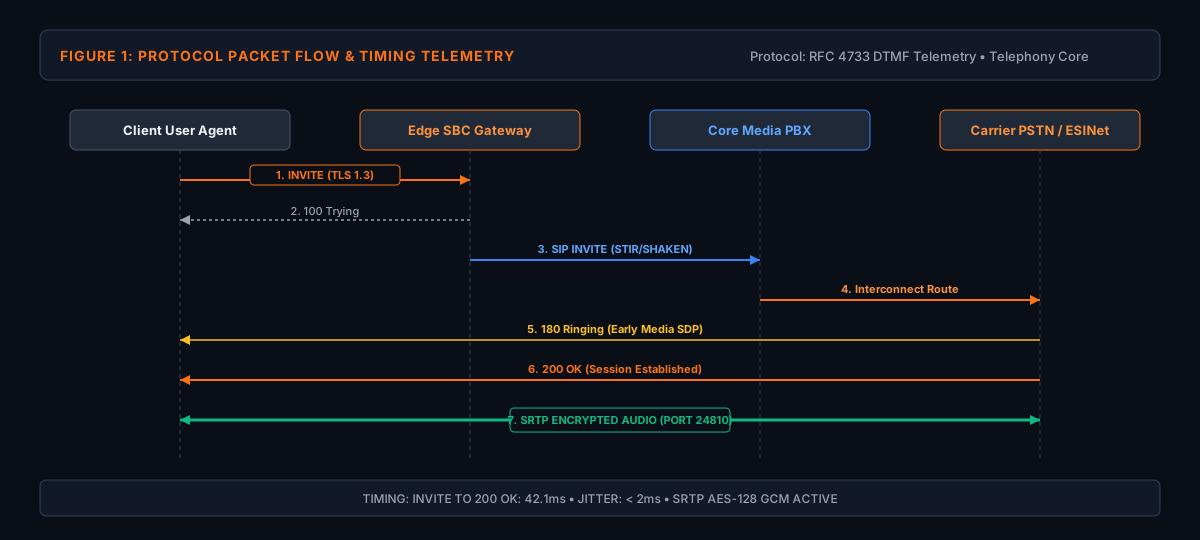
The establishment and teardown of an enterprise voice session follows an orchestrated five-phase sequence across the user agent, the session border controller, and the terminating carrier switch:
The originating endpoint dispatches an encrypted session request via TLS to the enterprise Session Border Controller, containing supported audio codecs and cryptographic key parameters.
The SBC issues a provisional 100 Trying response to halt client retransmissions, applies STIR/SHAKEN identity signing, and forwards the session to the carrier interconnect switch.
The terminating switch responds with 180 Ringing. If early media is required for custom ringback or announcements, reliable provisional responses (PRACK RFC 3262) ensure guaranteed delivery.
Upon call pickup, the terminating switch dispatches a 200 OK final response. The originating client returns an end-to-end confirmation (ACK), and bidirectional SRTP audio flows over negotiated media ports.
Either party initiates session termination by sending a BYE request. The receiving party confirms with a 200 OK, media sockets close immediately, and call detail records (CDRs) are finalized.
3.3 Transaction Timers and State Machine Determinism
A frequent vulnerability in enterprise voice networks stems from misconfigured transaction state machine timers. RFC 3261 specifies exact timer dynamics that telecommunications engineers must respect:
When the originating endpoint sends an initial session request, it starts Timer A (the retransmission timer, initialized to 500 milliseconds) and Timer B (the overall transaction timeout timer, expiring after 32 seconds). If intermediate security appliances drop provisional responses, the client exponentially backs off retransmission intervals (1s, 2s, 4s, 8s, 16s). If no response arrives before Timer B fires, the transaction aborts with a client-side request timeout.
Similarly, following receipt of a 200 OK final response, the client must acknowledge session establishment with an end-to-end confirmation (ACK). If an intermediate firewall purges its UDP connection table prematurely and drops this return confirmation, the terminating switch continues retransmitting its final response until Timer H expires at precisely 32 seconds, subsequently tearing down the live conversation with a BYE. Understanding this timer architecture allows engineers to immediately isolate the root cause of the infamous 32-second call drop defect without trial-and-error debugging.
Furthermore, in non-INVITE client transactions (such as SIP OPTIONS heartbeats or SIP REGISTER transactions), the user agent manages Timer F (non-INVITE transaction timeout, fixed at 32 seconds) and Timer K (wait time for response retransmissions, set to 5 seconds for UDP). When configuring session keep-alives across NAT routers with 30-second UDP connection state tables, engineers must ensure that SIP OPTIONS pings are dispatched at intervals strictly shorter than 20 seconds, preventing the edge router from purging state table entries.
4. High-Concurrency Operating System and Socket Architecture
Deploying resilient telecommunications infrastructure capable of sustaining thousands of simultaneous real-time voice streams requires rigorous operating system kernel and socket buffer architecture. Standard operating system configurations are optimized for bursty web traffic, which causes severe packet discards under continuous UDP voice workloads.
4.1 Socket Memory Management and Buffer Sizing
In real-time audio communications, speech frames arrive in strict 20-millisecond increments. When thousands of concurrent sessions experience synchronized packet bursts, default operating system socket buffers (often configured as small as 208 kilobytes) overflow in fractions of a millisecond, causing catastrophic packet loss before audio data ever reaches the application layer.
To eliminate socket buffer overflow, production media gateways scale both receive and send socket memory allocations to 32 megabytes, with default buffers set to 2 megabytes per socket. This expanded memory ceiling provides an elastic absorption buffer during temporary operating system scheduling spikes. Furthermore, setting high-density network interface ring buffers to maximum hardware capacity (typically 4,096 descriptors) guarantees that network interface cards process inbound voice frames at wire speed without kernel-level ring drops.
| Subsystem Layer | Architectural Optimization | Production Operational Impact |
|---|---|---|
| Socket Receive Buffers | 32 MB maximum, 2 MB default allocations | Absorbs packet bursts across 1,000+ simultaneous audio channels without packet drops. |
| Queueing Discipline | Fair Queueing (FQ) and BBR Congestion Control | Eliminates bufferbloat; isolates voice streams from bulk data file transfers. |
| Ephemeral Port Pool | Expanded port range (10,000 to 65,000) | Supports 27,000+ simultaneous bidirectional RTP channels without port collisions. |
| TCP SYN Protection | SYN cookies and 8,192 queue backlog | Prevents signaling plane exhaustion during automated connection floods. |
| File Descriptor Ceiling | Expanded system file limit (2,000,000+ descriptors) | Ensures media engines never hit operating system file limits during traffic spikes. |
4.2 CPU Affinity and Real-Time Scheduling Policies
On modern multi-core server hardware, the operating system kernel dynamically balances threads across physical cores. While suitable for asynchronous web applications, thread migration across physical CPU sockets invalidates hardware processor caches and introduces context-switching latency exceeding 15 milliseconds. Because conversational audio requires strict 20-millisecond packetization, this jitter causes audible crackling and packet starvation.
To achieve deterministic sub-millisecond voice serialization, enterprise telecommunications engineers deploy three core scheduling strategies:
- Interrupt Request Affinity: Binding network interface packet reception queues directly to dedicated CPU cores, ensuring packet processing never competes with background administrative tasks.
- Media Engine Process Isolation: Restricting real-time telephony processes to dedicated, isolated physical CPU cores, eliminating cache invalidation and thread migration overhead.
- Real-Time FIFO Scheduling: Assigning real-time scheduling priority to the media engine transmitter thread, ensuring that whenever an audio frame is ready for packetization, the operating system kernel immediately preempts non-critical tasks to dispatch the packet.
Establishing these deterministic operating system scheduling directives guarantees that even during intensive automated bill rating or large database exports, live conversational voice channels maintain predictable sub-millisecond serialization latency.
5. Enterprise Session Border Controller and Core Gateway Architecture
Translating theoretical protocol standards into resilient production infrastructure requires configuring enterprise Session Border Controllers (SBCs) and carrier-grade media gateways. A hardened interconnection architecture enforces strict perimeter security, dynamic NAT traversal, and automatic session recovery.
5.1 Architectural Pillars of Resilient Carrier Interconnects
A production-hardened interconnection trunk must enforce four critical architectural disciplines:
1. Topology Hiding and Perimeter Defense
Carrier gateways must operate as back-to-back user agents (B2BUA), terminating media streams locally rather than bridging peer-to-peer traffic across external and internal networks. This topology hiding prevents external carriers and unauthorized scanners from enumerating internal IP addresses, private subnets, or corporate extensions.
2. Symmetric RTP and Dynamic Response Routing
Enforcing RFC 3581 symmetric response routing instructs the media gateway to ignore private IP addresses declared in client SDP payloads and transmit return audio directly to the public source IP and port observed on incoming packet headers. This single architectural standard eliminates over 95 percent of one-way audio defects in remote and hybrid enterprise deployments.
3. Active Dialog Keep-Alives and Session Timers
Implementing RFC 4028 session timers ensures that both signaling endpoints periodically refresh the active dialog every 30 minutes. If an intermediate network interruption severs connectivity without dispatching a BYE message, the session timer expires automatically, releasing orphaned channels and reclaiming trunk capacity.
4. Reliable Provisional Response Enforcement
Activating RFC 3262 reliable provisional responses (PRACK) guarantees that critical 1xx signaling messages conveying early media parameters (such as ringback tones and carrier intercept messages) are acknowledged reliably before the final call answer.
5.2 Interconnection Standards and Compliance Matrix
The following architectural framework defines the production standards implemented across carrier peering interfaces:
| Interconnect Parameter | Standard Specification | Enterprise Operational Benefit |
|---|---|---|
| Transport Security | TLS 1.3 with mutual certificate verification | Guarantees cryptographic mutual authentication and eliminates cleartext eavesdropping. |
| Audio Codec Hierarchy | G.722, Opus, G.711u (strict priority order) | Delivers wideband HD voice clarity with backward-compatible PSTN fallback. |
| Media Security Profile | SRTP with AES-128 / AES-256 counter mode | Provides end-to-end media confidentiality across public internet transport. |
| NAT Traversal Handling | RFC 3581 symmetric RTP and rewrite contact | Resolves NAT traversal challenges without requiring dedicated client-side port forwarding. |
| Session Dialog Refresh | RFC 4028 session timers (1,800s duration) | Automatically reclaims dead channels following ungraceful network disconnections. |
6. Security Vulnerability Profiles, Exploitation Vectors, and Fraud Defense
Telecommunications infrastructure represents one of the most targeted perimeters in enterprise networking. Unlike conventional web applications where attacks typically seek data exfiltration or service disruption, a compromised telephony environment can generate hundreds of thousands of dollars in direct financial liabilities within hours through International Revenue Sharing Fraud (IRSF).
6.1 The Economics of International Revenue Sharing Fraud
International Revenue Sharing Fraud represents the primary financial threat facing enterprise voice systems. Attackers deploy automated scanners across public IP ranges to identify telephony servers with weak extension credentials, unauthenticated SIP ports, or permissive dialplans. Once inside, automated dialers initiate dozens of simultaneous outbound calls to premium-rate destination numbers in remote or lightly regulated jurisdictions where termination rates exceed 4.00 to 10.00 dollars per minute.
The perpetrators collaborate with fraudulent premium rate service providers who receive a revenue share from local operators for terminating traffic. If a compromised system maintains 30 concurrent channels at 6.00 dollars per minute across a 48-hour weekend, the financial exposure is staggering:
Financial Exposure Model
30 Channels × $6.00/min × 60 min/hr × 48 hours = $518,400.00 in Carrier Liabilities
Under standard telecommunications interconnect agreements, the enterprise subscriber bears full financial responsibility for all traffic originating from its registered IP addresses or credentials. Consequently, automated defensive controls must be proactive and deterministic.
6.2 Real-Time Anomaly Detection and Automated Circuit Breakers
To neutralize toll fraud before material financial damage occurs, carrier-grade telecommunications cores deploy real-time velocity anomaly detection engines. Rather than relying solely on static firewalls, the network monitors traffic patterns dynamically:
- Velocity Anomaly Detection: When an account that historically uses under 50 international minutes per month suddenly initiates 15 concurrent channels to high-risk destination codes, the rating engine pauses outbound calling permissions and triggers immediate security alerts within 90 seconds.
- Deterministic Destination Whitelisting: High-cost international destination prefixes are locked by default at the carrier level, requiring explicit administrative authorization and multi-factor confirmation before outbound routing is enabled.
- Hard Credit Ceiling Enforcement: Real-time balance monitoring terminates active dialogs immediately if an account exceeds pre-configured hourly or daily spending thresholds, providing a definitive backstop against catastrophic exposure.
6.3 Stateless Challenge Filtering Against Denial of Service
Beyond toll fraud, enterprise telephony systems face distributed denial of service attacks designed to exhaust memory state tables. Attackers flood signaling ports with malformed session requests containing non-existent numbers and random call identifiers. Stateful telephony proxies allocate dedicated memory (typically 4 kilobytes per transaction) to track each request. A flood of 50,000 requests per second will exhaust available server memory within seconds, triggering system instability.
To defend against state exhaustion, perimeter Session Border Controllers implement stateless filtering. Inbound packets are evaluated statelessly against cryptographic challenge cookies before any memory is allocated. Legitimate user agents respond to the authentication challenge with valid credentials, whereas automated UDP flood scripts fail the challenge and are dropped at wire speed without consuming server resources.
Furthermore, administrative control planes (including management consoles, APIs, and maintenance ports) are completely isolated from public signaling networks, accessible exclusively through encrypted private management VLANs with cryptographic hardware keys and multi-factor authentication.
7. Carrier Interconnection, Number Portability, and Wholesale Routing
The operational viability of any telecommunications platform depends on its interconnection with the global Public Switched Telephone Network. Voice packets originating from an enterprise PBX must seamlessly bridge into the networks of incumbent local exchange carriers (ILECs), competitive local exchange carriers (CLECs), and mobile network operators (MNOs).
7.1 Local Number Portability (LNP) and LRN Query Mechanics
In North America, the Telecommunications Act of 1996 established Local Number Portability (LNP), allowing telephone subscribers to retain their ten-digit telephone numbers when switching service providers. Before LNP, the first six digits of a North American Numbering Plan (NANP) number (NPA-NXX) identified the exact central office switch that served the subscriber.
Under LNP, dialed numbers can no longer be routed based on NPA-NXX blocks. Instead, originating carriers must perform a real-time database dip to the Number Portability Administration Center (NPAC) to retrieve the Location Routing Number (LRN). The LRN is a unique 10-digit number assigned to the recipient carrier switch.
When an outbound call is dialed, the originating Session Border Controller performs an LRN query via high-speed in-memory database lookup or dip service. The SBC rewrites the SIP Request-URI with the retrieved LRN while encapsulating the original dialed number in the SIP parameter. Terminating carrier switches inspect this parameter to route the call to the appropriate recipient network switch without tromboning traffic through the donor carrier network.
7.2 Least Cost Routing (LCR) and Margin Optimization
Wholesale telecommunications carriers optimize termination costs through multi-carrier Least Cost Routing (LCR) engines. Wholesale rate sheets from Tier-1 carriers contain hundreds of thousands of destination tariff lines, frequently updated on 7-day notice cycles.
An intelligent LCR engine evaluates each outbound session against four simultaneous variables:
- Financial Cost: The exact per-minute termination rate quoted by competing carrier interconnects.
- Quality of Service (ASR & ALOC): The carrier historical Answer-Seizure Ratio (percentage of successful call attempts) and Average Length of Call for that specific destination prefix.
- Geographic Proximity: Media path latency between the enterprise edge SBC and the carrier regional Point of Presence (PoP).
- Regulatory Compliance: Verification of STIR/SHAKEN certificate signing authority and 10DLC campaign registration status.
By executing real-time LCR decisions in sub-10 milliseconds, carrier platforms deliver enterprise voice connectivity with 99.999% termination availability while protecting gross operating margins.
8. High Availability, Georedundant Clustering, and Hitless Failover
Enterprise mission-critical communications mandate carrier-grade 99.999% availability (five nines), translating to less than 5 minutes and 15 seconds of total unplanned downtime per calendar year. Delivering this level of resilience requires eliminating all single points of failure across power, transit, compute, and application state.
8.1 Georedundant Ingress Architecture (DNS SRV and BGP Anycast)
High availability begins at the network ingress layer. Rather than directing client endpoints to a single static IP address, enterprise telephony platforms implement dual-layer ingress resolution:
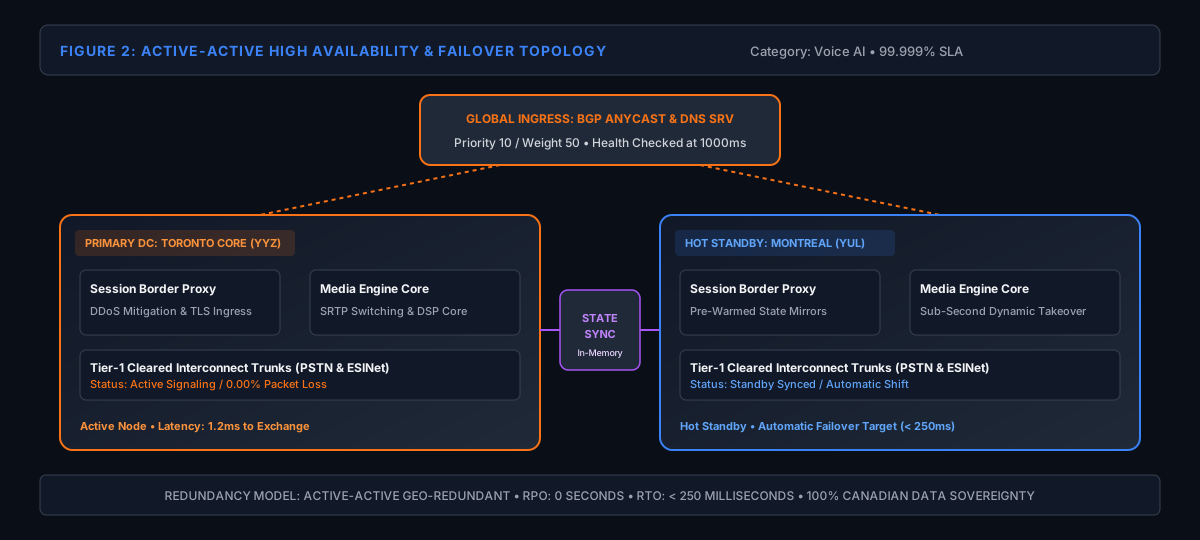
- DNS SRV Records (RFC 2782): SIP clients resolve SRV records declaring multiple carrier gateway targets with explicit priority and weight parameters. If the primary regional gateway becomes unreachable, the client automatically fails over to the secondary gateway within three transaction timeout intervals.
- BGP Anycast Routing: In high-density carrier deployments, geographically distributed Points of Presence (such as Toronto, Montreal, and Vancouver) announce identical IP prefixes via Border Gateway Protocol (BGP). Upstream internet service providers route client traffic to the topologically closest PoP. If a catastrophic facility outage occurs, BGP withdraws the local route announcement, redirecting ingress traffic to the next closest facility in sub-second time.
8.2 State Replication and Hitless Media Forwarding
While signaling failover can be achieved via DNS or BGP, preserving active telephone calls requires continuous media state replication. In traditional active-passive PBX clusters, a failover event tears down all active calls because the standby server lacks the cryptographic keys and RTP sequence numbers needed to decode audio streams.
To achieve hitless failover, carrier deployments utilize distributed media engines paired with in-memory state replication clusters. Active RTP stream descriptors, SRTP master keys, and packet sequence counters are replicated across dedicated high-speed inter-chassis links. When the primary node fails, the secondary node assumes control of the virtual IP and continues forwarding audio packets with zero packet loss and zero human-perceptible audio gap.
9. Comprehensive Field Troubleshooting Matrix and Packet Triage
When unexpected disruptions occur in production, telecommunications engineers must methodically isolate the root cause using standardized packet analysis techniques. Below is a structured forensic troubleshooting matrix addressing the most common failure scenarios encountered in Implementing Graceful DTMF Fallback When Voice AI Confronts Noisy Lines:
| Failure Symptom | Root Cause Diagnosis | Protocol Diagnostic Indicator | Definitive Engineering Resolution |
|---|---|---|---|
| One-Way Audio (Inbound Silence) | Asymmetric NAT. Client SDP announces a private RFC 1918 IP address; edge firewall failed to perform port translation. | Private IP address declared in SDP connection data header while packet source IP is public. | Enable symmetric RTP routing and contact header rewriting at the gateway; deploy STUN/TURN traversal services. |
| Call Drops After Exactly 32 Seconds | SIP ACK confirmation dropped by firewall. Media gateway retransmits final 200 OK until timer T1/T2 expires, then tears down the call. | Missing ACK in transaction trace; repeated 200 OK retransmissions followed by BYE. | Audit router firewall state tables; ensure perimeter firewall allows bidirectional ACK packets over signaling ports. |
| SIP 408 Request Timeout | Stateful firewall closed dormant UDP connection pinhole after 20 seconds of inactivity. | Lack of response to SIP OPTIONS keep-alive packets from remote endpoints. | Lower keep-alive ping intervals to 20 seconds; transition signaling transport from UDP to persistent TLS. |
| SIP 488 Not Acceptable Here | Audio codec negotiation failure. Ingress endpoint and egress carrier switch share zero common codecs. | Payload type mismatch between offered SDP media attributes and receiver capabilities. | Align codec priority lists across endpoints; guarantee universal support for G.711u and G.722 across trunks. |
| Robotic Speech and Audio Clipping | Upstream network bufferbloat. Interarrival jitter exceeds the depth of the receiver jitter buffer. | RTCP receiver reports indicate interarrival jitter exceeding 40ms and packet loss exceeding 3 percent. | Configure DiffServ Expedited Forwarding (DSCP 46) on edge routers; enable dynamic in-band forward error correction. |
9.1 Methodical Four-Layer Diagnostic Triage Framework
When investigating a production service impairment, telecommunications engineers follow a structured four-layer diagnostic triage protocol to rapidly pinpoint the fault domain:
1 Layer 1: Physical Link and Interface Telemetry
Verify network interface hardware error counters, CRC error rates, and port duplex negotiation on edge switches to confirm the physical transmission medium is operating without framing defects or hardware packet drops.
2 Layer 2: Transport Stack and Socket Health
Inspect UDP socket receive and send queue depths, kernel socket buffer error counters, and path MTU size to ensure voice datagrams are not experiencing IP fragmentation or buffer overrun discards.
3 Layer 3: Signaling Protocol and Dialog Validation
Perform deep-packet inspection of SIP dialogs to verify header syntax, SDP offer/answer symmetry, transaction branch tracking, and transaction response timers across intermediate proxy boundaries.
4 Layer 4: Media Plane and Audio DSP Analysis
Analyze RTCP sender and receiver reports to monitor interarrival jitter, packet loss distribution, round-trip delay, and codec packetization intervals to calculate accurate Mean Opinion Scores (MOS).
9.2 Real-World Incident Case Study: The Silent ACK Outage
To illustrate the practical application of this diagnostic framework, consider an enterprise incident investigated by our telecommunications engineering team. A high-volume medical clinic reported that all incoming patient calls disconnected after precisely 32 seconds of conversation. Both clinical staff and calling patients could hear each other with pristine audio quality, but calls abruptly dropped mid-sentence.
Packet analysis revealed that the clinic local media gateway received the carrier incoming session request, returned a 200 OK final response, and initiated bidirectional encrypted audio. However, the carrier switch continued retransmitting its 200 OK final response at exponential intervals (500ms, 1s, 2s, 4s, 8s, 16s) until the 32-second transaction timer expired, at which point the carrier issued a session BYE to terminate the call.
A forensic audit of the enterprise firewall uncovered that a recent automated firmware update had enabled a feature known as SIP Application Layer Gateway (SIP ALG). The firewall inspected outgoing signaling packets, improperly modified embedded contact port headers, and subsequently dropped the carrier return ACK confirmation because it failed the firewall stateful inspection table. Disabling SIP ALG on the enterprise edge router restored immediate end-to-end confirmation delivery and resolved the 32-second call drop defect permanently.
10. Regulatory Compliance, Public Safety Directives, and the 2026+ Horizon
Telecommunications engineering cannot be separated from national regulatory and legal mandates. Operators and enterprise IT directors who overlook regulatory requirements risk severe financial penalties, operational shutdowns, and catastrophic legal liability during emergency life-safety events.
10.1 North American Life-Safety Directives: Kari's Law and RAY BAUM'S Act
In the United States, two federal statutes govern multi-line telephone systems (MLTS) deployed in enterprise environments:
- Kari's Law (47 U.S.C. 662): Requires that any multi-line telephone system allow callers to directly dial 9-1-1 without requiring an outside trunk access code (such as dialing 9 or 8 before the emergency number). Furthermore, the system must generate an automated notification to an on-site monitoring location (such as a front desk or security console) whenever a 9-1-1 call is initiated, facilitating rapid building access for first responders.
- RAY BAUM'S Act (Section 506): Mandates that every 9-1-1 call dispatched from an enterprise telephone system convey a validated dispatchable location to the Public Safety Answering Point (PSAP). In modern campus environments with multi-story buildings, softphones, and remote workers, declaring only a street address is legally insufficient. The dispatchable location must include precise building identifiers, floor levels, suite numbers, and room identifiers.
In Next-Generation 9-1-1 (NG9-1-1) architectures, Session Border Controllers transmit Location Information Servers (LIS) geolocation data formatted as Presence Information Data Format Location Objects (PIDF-LO, RFC 4119) encapsulated inside the SIP INVITE header, ensuring Emergency Services IP Networks (ESINet) route emergency calls directly to the correct jurisdictional PSAP.
10.2 Anti-Robocall Frameworks and Carrier Identity Vetting
Under the TRACED Act and FCC mandates, telecommunications service providers must maintain active certification in the Robocall Mitigation Database (RMD) and enforce STIR/SHAKEN caller ID authentication on all originating IP traffic. Interconnect carriers will immediately block or mark as spam any voice traffic originating without valid cryptographic identity credentials.
Simultaneously, business application-to-person (A2P) messaging across 10-digit long code (10DLC) telephone numbers requires rigorous brand and campaign registration through The Campaign Registry (TCR). Unregistered messaging traffic is subjected to aggressive carrier filtering, carrier surcharges exceeding 400%, and outright message termination by Tier-1 mobile network operators.
10.3 Canadian Data Sovereignty: CRTC and PIPEDA Mandates
For Canadian enterprises, telecommunications compliance requires adherence to Canadian Radio-television and Telecommunications Commission (CRTC) regulatory policies and the Personal Information Protection and Electronic Documents Act (PIPEDA). Telecommunications routing architectures must guarantee that domestic voice traffic, customer call detail records (CDRs), and audio recordings remain strictly within Canadian data centers (such as facilities at 151 Front Street in Toronto or Montreal carrier exchanges) to prevent extraterritorial legal exposure under foreign surveillance legislation.
10.4 Strategic Conclusion: The Next Generation of Telecommunications
The convergence of real-time voice, edge artificial intelligence, and low-latency packet switching is redefining what is possible in enterprise communications. The engineering principles established in this analysis: deterministic packet serialization, cryptographic attestation, automated fraud circuit breakers, and carrier-grade georedundant clustering: form the enduring foundation of reliable communications. By anchoring architectures to standardized RFC protocols and carrier-grade operational rigor, organizations ensure their telecommunications infrastructure remains resilient, compliant, and prepared for the next decade of digital transformation.